 The Eiffel Tower is an iron tower built on the Champ de Mars beside the Seine River in Paris. The tower has become a global icon of France and is one of the most recognizable structures in the world. Named after its designer, engineer Gustavo Eiffel, the Eiffel Tower is the tallest building in Paris. More than 200,000,000 people have visited the tower since its construction in 1889, including 6,719,200 in 2006, making it the most visited paid monument in the world. Including the 24 m (79 ft) antenna, the structure is 324 m (1,063 ft) high (since 2000), which is equivalent to about 81 levels in a conventional building. At the time of completion in 1889, it was the world's tallest tower — a title it retained until 1930 when New York City's Chrysler Building (319 m — 1,047 ft tall) was completed. The tower is now the fifth-tallest structure in France and the tallest structure in Paris, with the second-tallest being the Tour Montparnasse (210 m — 689 ft), although that will soon be surpassed by Tour AXA (225.11 m — 738.36 ft). The metal structure of the Eiffel Tower weighs 7,300 tones while the entire structure including non-metal components is approximately 10,000 tones. Depending on the ambient temperature, the top of the tower may shift away from the sun by up to 18 cm (7 in) because of thermal expansion of the metal on the side facing the sun. The tower also sways 6–7 cm (2–3 in) in the wind. The structure was built between 1887 and 1889 as the entrance arch for the Exposition Universally, a World's Fair marking the centennial celebration of the French Revolution. Eiffel originally planned to build the tower in Barcelona, for the Universal Exposition of 1888, but those responsible at the Barcelona city hall thought it was a strange and expensive construction, which did not fit into the design of the city. After the refusal of the Consistory of Barcelona, Eiffel submitted his draft to those responsible for the Universal Exhibition in Paris, where he would build his tower a year later, in 1889. The tower was inaugurated on 31 March 1889, and opened on 6 May. Three hundred workers joined together 18,038 pieces of puddle iron (a very pure form of structural iron), using two and a half million rivets, in a structural design by Maurice Koechlin. The risk of accident was great, for unlike modern skyscrapers the tower is an open frame without any intermediate floors except the two platforms. However, because Eiffel took safety precautions, including the use of movable staging, guard-rails and screens, only one man died. (Source:http://en.wikipedia.org/wiki/Eiffel_Tower)
Friday, June 5, 2009
The Eiffel Tower
The Eiffel Tower is an iron tower built on the Champ de Mars beside the Seine River in Paris. The tower has become a global icon of France and is one of the most recognizable structures in the world. Named after its designer, engineer Gustavo Eiffel, the Eiffel Tower is the tallest building in Paris. More than 200,000,000 people have visited the tower since its construction in 1889, including 6,719,200 in 2006, making it the most visited paid monument in the world. Including the 24 m (79 ft) antenna, the structure is 324 m (1,063 ft) high (since 2000), which is equivalent to about 81 levels in a conventional building. At the time of completion in 1889, it was the world's tallest tower — a title it retained until 1930 when New York City's Chrysler Building (319 m — 1,047 ft tall) was completed. The tower is now the fifth-tallest structure in France and the tallest structure in Paris, with the second-tallest being the Tour Montparnasse (210 m — 689 ft), although that will soon be surpassed by Tour AXA (225.11 m — 738.36 ft). The metal structure of the Eiffel Tower weighs 7,300 tones while the entire structure including non-metal components is approximately 10,000 tones. Depending on the ambient temperature, the top of the tower may shift away from the sun by up to 18 cm (7 in) because of thermal expansion of the metal on the side facing the sun. The tower also sways 6–7 cm (2–3 in) in the wind. The structure was built between 1887 and 1889 as the entrance arch for the Exposition Universally, a World's Fair marking the centennial celebration of the French Revolution. Eiffel originally planned to build the tower in Barcelona, for the Universal Exposition of 1888, but those responsible at the Barcelona city hall thought it was a strange and expensive construction, which did not fit into the design of the city. After the refusal of the Consistory of Barcelona, Eiffel submitted his draft to those responsible for the Universal Exhibition in Paris, where he would build his tower a year later, in 1889. The tower was inaugurated on 31 March 1889, and opened on 6 May. Three hundred workers joined together 18,038 pieces of puddle iron (a very pure form of structural iron), using two and a half million rivets, in a structural design by Maurice Koechlin. The risk of accident was great, for unlike modern skyscrapers the tower is an open frame without any intermediate floors except the two platforms. However, because Eiffel took safety precautions, including the use of movable staging, guard-rails and screens, only one man died. (Source:http://en.wikipedia.org/wiki/Eiffel_Tower) 

Sunday, May 31, 2009
Kangchenjunga Hill
 Kangchenjunga is the third highest mountain in the world (after Mount Everest and K2), with an elevation of 8,586 meters (28,169 ft). Kangchenjunga translated means "The Five Treasures of Snows", as it contains five peaks, four of them over 8,450 meters, the treasures representing the five repositories of God, which are gold, silver, gems, grain, and holy books. Kangchenjunga is also called SewaLungma in the local Limbu language and is considered sacred in the Kirant religion. Three of the five peaks (main, central, and south) are on the border of North Sikkim district of Sikkim, India and Taplejung District of Nepal, while the other two are completely in Taplejung District. Nepal is home to the Kangchenjunga Conservation Area Project run by the World Wildlife Fund, in association with HMG in Nepal, the sanctuary is also home to the Red Panda and other snow animals, birds and plants. India's side of Kangchenjunga also has a protected park area called the Khangchendzonga National Park. Although Kangchenjunga is the official spelling adopted by Douglas Freshfield, A.M. Kellas, and the Royal Geographical Society that gives the best indication of the Tibetan pronunciation, there are a number of alternative spellings which include Kangchen Dzö-nga, Khangchendzonga, Kanchenjanga, Kachendzonga, Kanchenjunga or Kangchanfanga. The final word on the use of the name Kangchenjunga came from His Highness Sir Tashi Namgyal, the Maharaja or chogyal of Sikkim, who stated that "although junga had no meaning in Tibetan, it really ought to have been Zod-nga (treasure, five) Kang-chen (snow, big) to convey the meaning correctly". Following consultations with a Lieutenant-Colonel J.L.R. Weir (HMG political agent to Sikkim), he agreed that it was best to leave it as Kangchenjunga, and thus the name remained so by acceptance and usage. Until 1852, Kangchenjunga was assumed to be the highest mountain in the world, but calculations made by the British Great Trigonometric Survey in 1849 came to the conclusion that Mount Everest (known as Peak XV at the time) was the highest and Kangchenjunga the third-highest. Kangchenjunga was first climbed on May 25, 1955 by Joe Brown and George Band of a British expedition. The British expedition honored the beliefs of the Sikkimese, who hold the summit sacred, by stopping a few feet short of the actual summit. Most successful summit parties since then have followed this tradition. (Source: http://en.wikipedia.org)
Saturday, May 30, 2009
Big Ben
 Big Ben is the nickname for the great bell of the clock at the north-eastern end of the Palace of Westminster in London. The nickname is often also used to refer to the clock and the clock tower. This is the world's largest four-faced, chiming clock and the third largest free-standing clock tower in the world. It celebrates its 150th birthday in 2009, during which celebratory events are planned. The nearest London Underground station is Westminster on the Circle, District and Jubilee lines. The clock faces are large enough to have once allowed the Clock Tower to be the largest four-faced clock in the world, but have since been outdone by the Allen-Bradley Clock Tower in Milwaukee, Wisconsin. However, the builders of the Allen-Bradley Clock Tower did not add chimes to the clock, so the Great Clock of Westminster still holds the title of the "world's largest four-faced chiming clock". The face of the Great Clock of Westminster. The hour hand is 2.7 metres (9 ft) long and the minute hand is 4.3 metres (14 ft) long. The clock and dials were designed by Augustus Pugin. The clock faces are set in an iron frame 7 metres (23 ft) in diameter, supporting 312 pieces of opal glass, rather like a stained-glass window. Some of the glass pieces may be removed for inspection of the hands. The surround of the dials is gilded. At the base of each clock face in gilt letters is the Latin inscription DOMINE. (Source: http://en.wikipedia.org/)

National Parliament of Bangladesh
 Jatiyo Sangshad or National Assembly is the national parliament of Bangladesh. It is one of the most majestic public buildings in Bangladesh. The National Parliament (Sangsad Bhaban) complex is located at Sher-e-Bangla Nagar of Dhaka city. The current parliament of Bangladesh contains 345 seats including 45 women reserved seats distributed on elected party position in the parliament, the occupants of which are called Members of Parliament or MPs.The National Parliament Building is an architectural masterpiece for which the nation can be said to be justifiably proud. The decision to construct the National Parliament Complex at Dhaka was originally taken in 1959. Louis I Kahn. One of the greatest architects of the time was initially selected for designing the complex. Which would include the National Parliament Building. Hostels for members of parliament. Ministers and secretaries. Hospitality halls and communally buildings. All linked by roads and walkways and surrounded by attractive gardens and lakes. The main characteristic of the building is its monumentally. The mass of concrete lined with marble strips, the outer wall punctuate by pure geometrical openings and the dominating circular and rectangular concrete masses impart a supreme monumentality to the building quite suited to its noble function. The main building complex consists of nine individual blocks, of which eight at its periphery rise to a height of 35 meters, while the octagonal block at the centre shoots up to 52 meters. The central block accommodates the Parliament chamber with a capacity of 354 seats for members of the parliament. The entire complex has a floor area or 76,487 SQ meters in the main building, 20725 sq meters in the South Plaza and 6,041 sq meters in the North Plaza. There is not a single column in the entire building. Hollow columns that are parts of space enclosures have been adapted as structural supports. One of the important considerations in designing the building was protection from the sun and rain. The structure provides a visual impression or a majestic edifice. It avoided the conventional method of placing windows in the exterior and the disadvantages of monumental composition were removed by the provision of core walls with small gaps in between. Architecturally, the complex marks a distinct departure from the rest of the modern buildings in Dhaka.

Shwedagon Pagoda
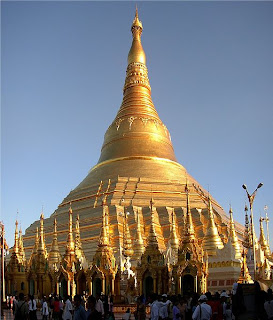 The Shwedagon Pagoda also known as the Golden Pagoda, is a 98-metre (approx. 321.5 feet) gilded stupa located in Yangon, Burma. The pagoda lies to the west of Kandawgyi Lake, on Singuttara Hill, thus dominating the skyline of the city. It is the most sacred Buddhist pagoda for the Burmese with relics of the past four Buddhas enshrined within, namely the staff of Kakusandha, the water filter of Konagamana, a piece of the robe of Kassapa and eight hairs of Gautama, the historical Buddha. According to legend, the Shwedagon Pagoda is 2500 years old. Archaeologists believe the stupa was actually built sometime between the 6th and 10th centuries by the Mon, but this is a very controversial issue because according to the records by Buddhist monks it was built before Lord Buddha died in 486 BC. The story of Shwedagon Pagoda begins with two merchant brothers, Taphussa and Bhallika, from the land of Ramanya, meeting the Lord Gautama Buddha and receiving eight of the Buddha's hairs to be enshrined in Burma. The two brothers made their way to Burma and with the help of the local king, King Okkalapa, found Singuttara Hill, where relics of other Buddhas preceding Gautama Buddha had been enshrined. When the hairs were taken from their golden casket to be enshrined some incredible things happened:
“There was a tumult among men and spirits ... rays emitted by the Hairs penetrated up to the heavens above and down to hell ... the blind beheld objects ... the deaf heard sounds ... the dumb spoke distinctly ... the earth quaked ... the winds of the ocean blew ... Mount Meru shook ... lightning flashed ... gems rained down until they were knee deep ... all trees of the Himalayas, though not in season, bore blossoms and fruit”
The stupa fell into disrepair until the 1300s when the Mon king Binnya U of Bago had the stupa rebuilt to a height of 18 meters (60 ft). It was rebuilt several times and reached its current height of 98 meters (320 ft) in the 15th century. The Mon kingdom possessed two great pagodas of especial sanctity, the Shwemawdaw at Bago and the Shwedagon. Originally only twenty-seven feet high, it was raised to a height of sixty-six feet in 1362 by King Binnya U as an act of special piety. Dhammazedi's immediate predecessor, his mother-in-law Queen Shinsawbu (1453-72), raised its height to 40 meters (129 ft). She terraced the hill on which it stands, paved the top terrace with flagstones, and assigned land and hereditary slaves for its maintenance. When in 1472 she yielded up the throne to Dhammazedi, she retired to Dagon, and during her last illness had her bed placed so that she could rest her dying eyes upon the gilded dome of the sacred fane. The Mon face of the Shwe Dagon inscription catalogues a list of repairs beginning in 1436 and finishing during Dhammazedi's reign. It mentions Queen Shinsawbu under a terrific Pali name of sixty-six letters. By the beginning of the sixteenth century the pagoda had become the most famous place of pilgrimage in Burma. A series of earthquakes during the next centuries caused damage. The worst damage came from a 1768 earthquake that brought down the top of the stupa and it was raised to its current state by King Hsinbyushin (lit. Lord of the White Elephant) of Konbaung Dynasty. A new hti or crown was donated by King Mindon Min in 1871 after the annexation of Lower Burma by the British. (Source: http://en.wikipedia.org)
Subscribe to:
Posts (Atom)